Student Profiles
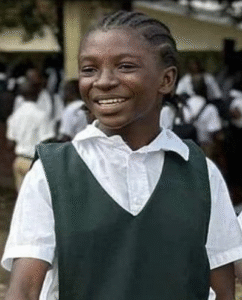
Bertha Steward
My name is Bertha Yatta Steward, born on October 1, 2010, in Gbatala, Bong County, Liberia.
Life has never been gentle with me. Only two months after my birth, my mother became mentally ill, leaving me and my two brothers in the care of my aunty. From then on, struggle became my daily companion.
I longed for education, but poverty stood like a wall before me. I began at Royal Kids Academy and later the Conference School System, reaching second grade. But when there was no money, I had to drop out. I would watch other children walk proudly to school while I stayed behind, my heart heavy with sadness, wondering why life was so unfair.
My aunty, though poor herself, fought for me. She worked at City Hill Mission School just to help me continue from grade two to grade seven. But again, hardship pulled me out of the classroom. At times, I felt forgotten and hopeless.
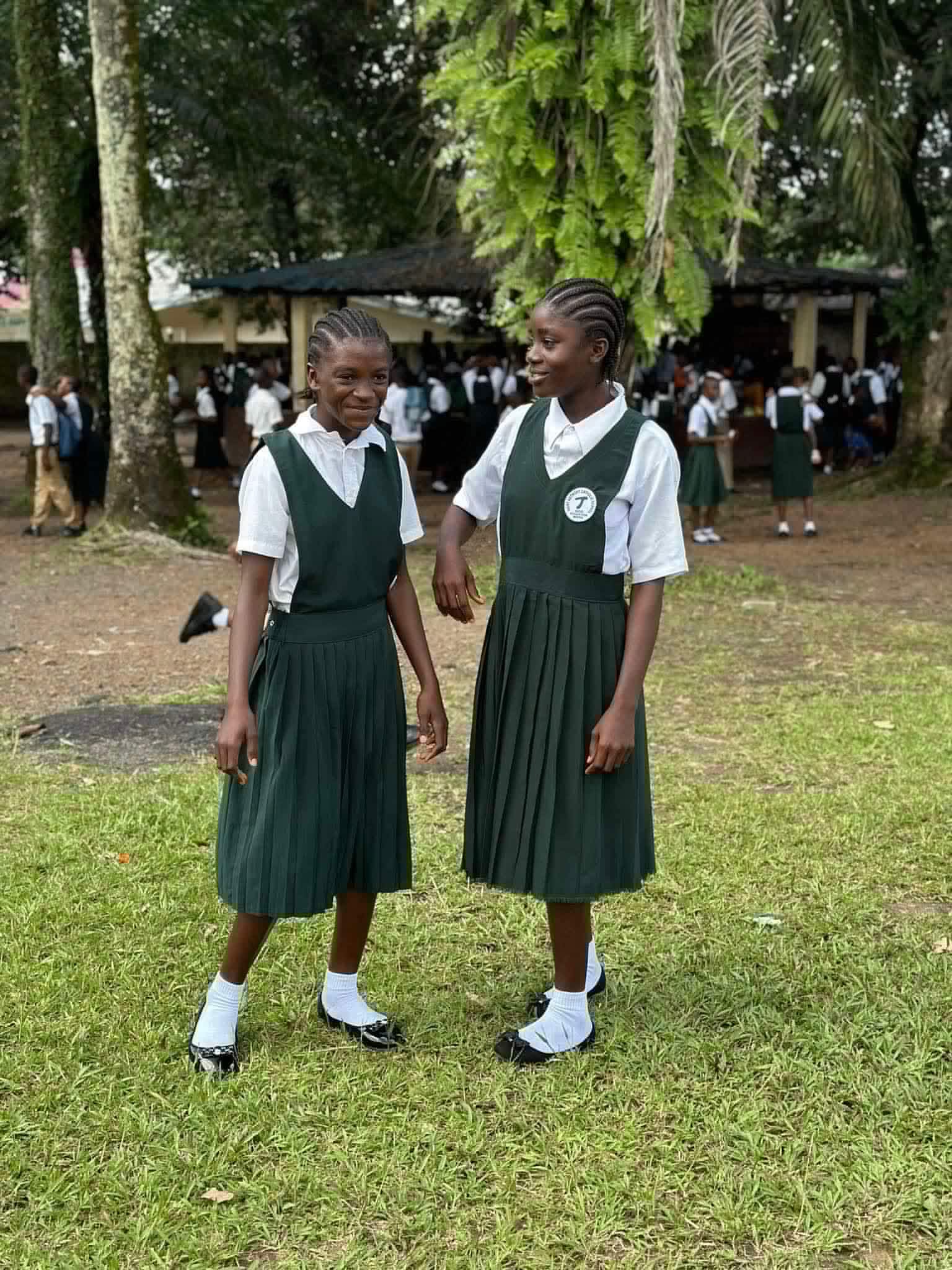
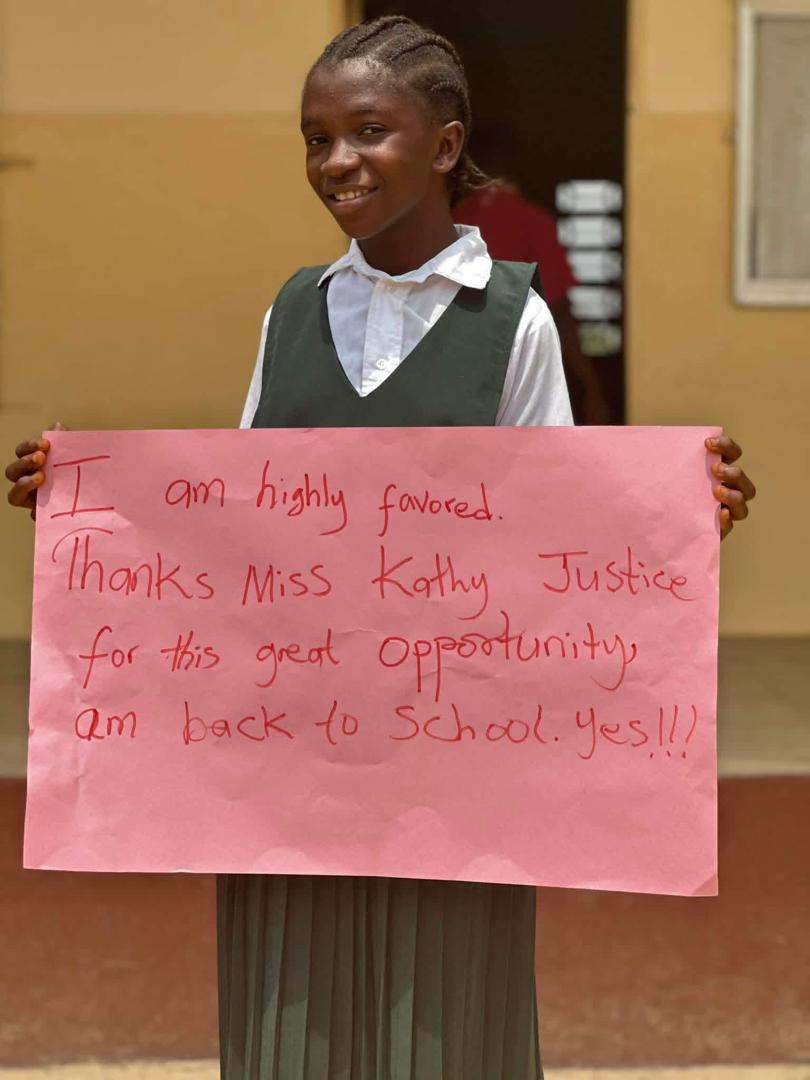
Then the Kathy Justice Girls Educational Foundation came into my life like light in the darkness. Their support gave me a second chance. Today, as a ninth grader, I study with tears of gratitude, knowing education is the only key to rewrite my story.
Lorpu Harris
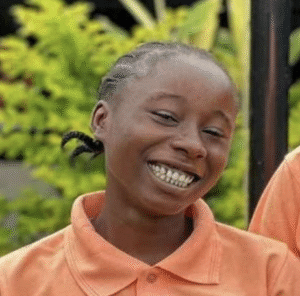
My name is Lorpu Harris. I was born in 2006 and raised in Gbarnga, Bong County.
Life has not been easy for me. My mother is a small businesswoman who works tirelessly to support me and my siblings, but her income has never been enough to meet all our needs. Because of this, I had to stay out of school for several years. Those days were filled with sadness and frustration, watching my friends go to school while I stayed at home, longing for the chance to learn and grow. I often wondered if I would ever be able to finish high school or pursue my dream of becoming a journalist, someone who could raise the voices of women who are often ignored.
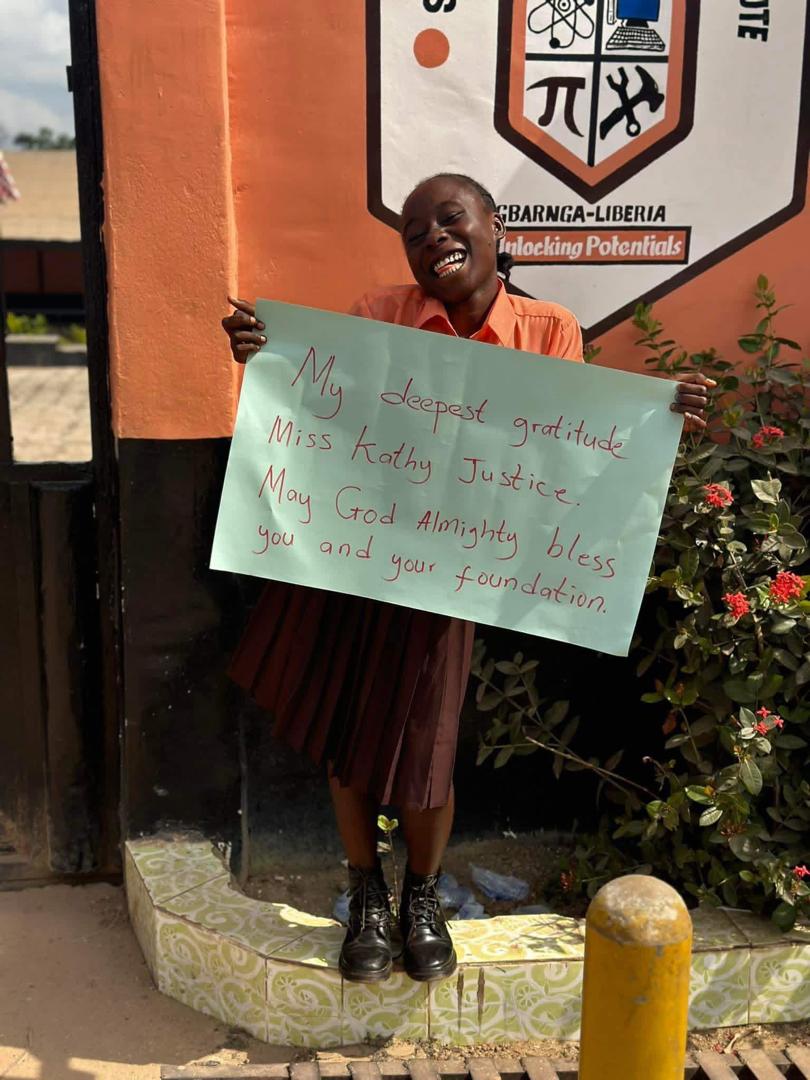
Those difficult moments, however, did not break my spirit. They taught me resilience, patience, and the value of determination. In 11th grade, the Kathy Justice Girls Education Foundation became my lifeline. Through their support, I was able to return to school and continue my education, despite the financial hardships my family faces. Their help renewed my hope and gave me the opportunity to chase my dreams.
Today, I am preparing to graduate from high school—a milestone that once seemed impossible. This achievement is more than a certificate; it is proof that hope and perseverance can overcome even the darkest challenges. My journey has been marked by struggle, tears, and uncertainty, but it has also been filled with growth, gratitude, and resilience.
As I step forward, I carry with me a commitment to use my voice to empower women and girls, just as others have empowered me. I am determined to transform the hardships of my past into inspiration for the future, proving that no obstacle is too great when one has courage, faith, and support.
Princess Kweinah
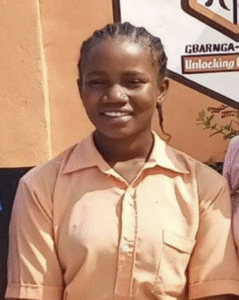
My name is Princess Kweinah, and I come from Bong County, in north-central Liberia.
Life for me has not been easy. My father, Andrew Kweinah, is blind, and my mother, Josephine Suah, has no source of income. Growing up in such a situation has been very difficult, especially when it came to education.
My parents love me deeply, but because of their condition, they have not been able to provide the financial support I needed to stay in school. Many times, I wondered if I would ever reach this far, or if my dream of graduating high school would fade away.
But today, I am filled with joy and gratitude because of the support I have received from Miss Justice and the entire KJGEF team. Through their kindness and sacrifice, my story has taken a different path. They stood by me when my family could not, giving me hope and strength to continue. This year, I will be graduating from high school, something I once thought was impossible.
If it had not been for your help, I would not be here today. Thank you plenty for your love, your support, and for believing in me when life was so hard.
We Work Together
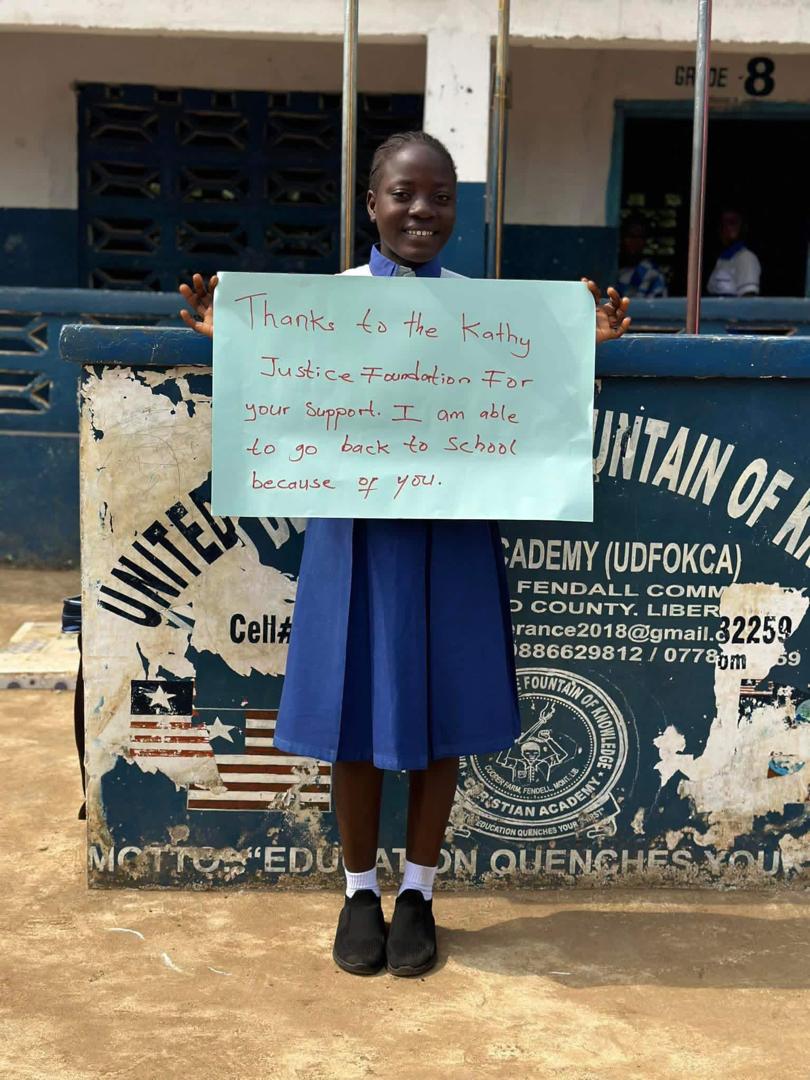
The mission of the Kathy Justice Girls Educational Foundation is to help support disadvantaged girls who are willing to go back to school and help contribute to serving the needs of their community through collaboration with civic groups, and other faith groups.
Why is educating girls important?
The number of countries that achieved gender parity in both primary and secondary education from 2000 to 2015 increased from 36 to 62. But the overall improvement does not tell the full story. Some parts of the world, including sub-Saharan Africa and South and West Asia, are not making as much progress.
Only two of 35 countries in sub-Saharan Africa have equal numbers of girls and boys in school – the lowest proportion of countries with gender parity according to the Education Commission’s Learning Generation report in 2016.
According to an International Labor Organization report, “Educating girls has proven to be one of the most important ways of breaking poverty cycles and is likely to have significant impacts on access to formal jobs in the longer term.”
Benefits of girls’ education in third world countries
Education for girls and boys increases productivity and contributes to economic growth. Globally, women are not in the formal job market as much as men, but many studies show there are economic benefits if they are allowed to join the labor force.
Educating girls and young women increases a country’s productivity and contributes to economic growth. Some countries lose more than $1 billion a year by failing to educate girls to the same level as boys. A woman with an education can get a better job with higher wages which has the effect of addressing gender imbalances in the labour force.
According to an International Labor Organization report, “Educating girls has proven to be one of the most important ways of breaking poverty cycles and is likely to have significant impacts on access to formal jobs in the longer term.”
Why Girl’s Education In Liberia?
Education continues to be the victim in war-ravaged Liberia, with what facilities there are, found mainly in the state capital Monrovia. State schools are poorly operated and private school fees are beyond the reach of the nation’s poor. Most of the schools in the country are operated by churches or Christian missions, among which are the Catholic Church, Methodist, Episcopal, and a few others.
It is quintessential to be reminded that education is a basic human right. Yet in Liberia, children’s access to education is limited by numerous factors including constraints on national finances, poor infrastructure, and unskilled teachers.
The education sector in Liberia faces a complex set of challenges related to rebuilding and recovery from civil war, constrained national finances, poor infrastructure, and the Ebola epidemic. These challenges include poor learning outcomes, overage enrolment, a huge number of out-of-school children, wasted government resources because of ‘ghost’ teachers and unskilled teachers, and many unqualified teachers.
On a systemic level, there are no national school quality standards, and capacity and resources at county and district levels require improvement. The education sector also faces serious equity challenges including important geographic differences in access to quality education.
Summary Of Our Aim For Students.
To Achieved:
- Outstanding results
- Excellent presentation and academic performance
To Do:
- Develop leadership skills
- Learn and develop through success, challenges, mistakes, and failures
To Understand:
- That learning is about understanding
- Your identity and responsibility are global
To Be:
- Decision makers guided by values and moral integrity
- Confident and successful young adults
Become a volunteer
Join us for a better life and beautiful future
The mission of the Kathy Justice Girls Educational Foundation is to help support disadvantaged girls who are willing to go back to school and help contribute to serving the needs of their community through collaboration with civic groups, and other faith groups.
Please Email Applications to:
thomassaydee@gmail.com
kathyfoundation@outlook.com